
The term "courses for English 12" primarily refers to the mandatory graduation requirement course, English Studies 12, and the various elective English courses that high school students can take in their senior year for deeper specialization
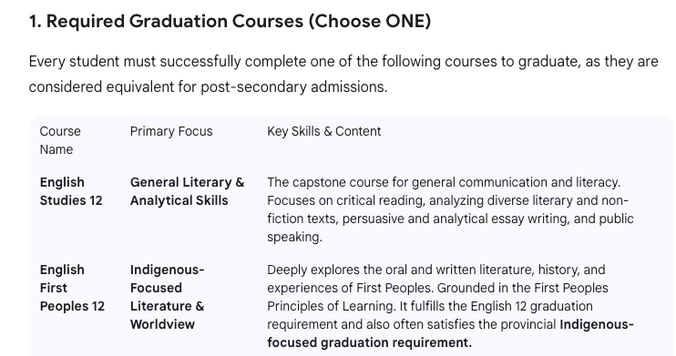
***The "No. 1" course from the previous English 12 summary is the Required Graduation Course: English Studies 12 (or its equivalent, English First Peoples 12).Here is an in-depth look at English Studies 12, which is the standard, compulsory English course for high school graduation and post-secondary admission in many Canadian provinces.1. English Studies 12 (MENST12) 🎓English Studies 12 is the crucial, four-credit course that serves as the culmination of a student's K-12 English Language Arts education.
It is designed to bridge high school literacy with the demands of post-secondary academics and the professional world.A. Core PurposeThe primary goal of English Studies 12 is not simply to read classic literature, but to develop advanced critical thinking, complex communication, and sophisticated literacy skills that are essential for success beyond high school.B. "Big Ideas" in DepthThe curriculum is structured around three overarching themes (or "Big Ideas") that students explore through diverse texts:Identity and Perspective: How does literature and storytelling deepen our understanding of ourselves, others, and the world? This involves analyzing texts from various cultural, historical, and individual perspectives to understand bias and context.
The Power of Language: How do people use language to create, shape, and challenge ideas? This involves studying rhetoric, propaganda, literary devices, and the way language constructs social and cultural identity.Reconciliation (In British Columbia): How can text and story help us understand the lived realities of First Peoples and appreciate our responsibilities toward Reconciliation? This mandated component ensures all students engage with authentic Indigenous voices, oral traditions, and histories
Grade 12 & Advisory article
Recommendation

-
Check University Requirements: Ensure the course you take meets the minimum English requirement for the post-secondary programs you are applying to (e.g., a minimum grade in English Studies 12).Align with Interests: If you love reading novels, take Literary Studies 12. If you want to study journalism or digital marketing, take New Media 12. If you want to major in the humanities, consider Composition 12 or AP English.Consult Your Counselor: Always confirm the specific courses and their equivalent standing at your individual school, as offerings can vary
Here is a breakdown of the typical English 12 courses available in a comprehensive high school curriculum (based on the British Columbia curriculum model, which is common across Canada)

General Discussion
At the end of each grade taking this course the general expectation is that by Grade 8 you shuld be ablle to write a proper paragraph, Grade 9 you should be able to write a multi paragrah, Grade 10 you should be able to write a small essay , Grade 11 should be abe to write a full 5 paragraph essay and by Grade 12 know the ful components of english including writing essays, short stories and applying language skills. A teacher recommends grammaly for students who struggle th writing and spark point for students who struggle with understanding Shakes spear and online dictionaries to expand your vocabulary
-
Post-Secondary RelevanceEnglish Studies 12 is critical because:Graduation Requirement: It is the final mandatory course required to receive a high school diploma.Admission Requirement: It is typically the single most important course used to determine eligibility for virtually all university and college programs. Universities often require a minimum grade (e.g., 67% or 70%) in English 12, as a strong indicator of a student's preparedness for post-secondary studies.Skill Foundation: The analytical and writing skills practiced—especially the ability to synthesize complex ideas and write persuasive, evidence-based arguments—are directly transferable to introductory university courses across all faculties, from Arts and Humanities to Science and Business